
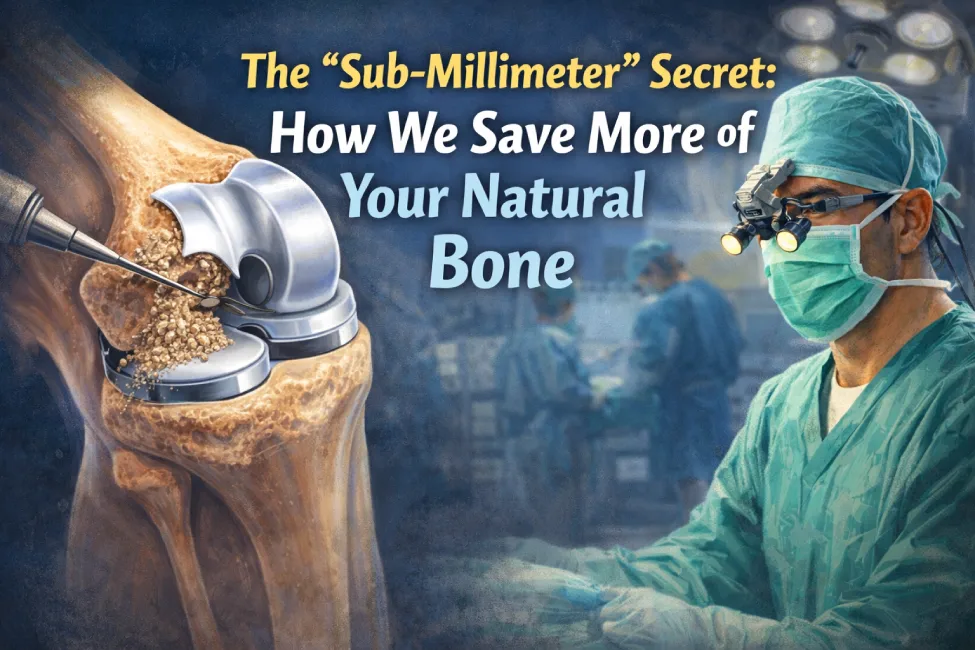
There is a terrifying image that many patients have when they think of Knee Replacement. They imagine the surgeon taking a large saw and “chopping off” the entire knee joint to replace it with metal. It sounds barbaric. It sounds like an amputation.
I am here to tell you: That is NOT what we do. And with the arrival of the CUVIS Active Robot, we are doing less “chopping” than ever before.
Modern knee replacement is not really a “replacement.” A better term would be “Resurfacing.” We are simply peeling off the damaged, rough cartilage and capping it with a thin metal shield. And in this process, saving your natural bone is the holy grail.
The Gold Dust: Why Your Bone Matters
Why am I so obsessed with saving millimeters of your bone? Because bone is like money in the bank. You don’t want to spend it all at once.
- The “Revision” Reality: If you are 50 or 60 years old today, there is a chance you might need a second surgery (Revision) when you are 80. In a revision surgery, we need natural bone to anchor the new implant. If the first surgeon removed too much bone, the second surgery becomes very difficult.
- Ligament Tension: Your natural bone anchors your ligaments. The more bone I save, the more natural stability your knee retains.
Man vs. Machine: The “Over-Cutting” Problem
In traditional manual surgery, we use metal jigs to guide the saw. These jigs are “one size fits all.” To be safe, manual instrumentation often requires us to make a standard cut that might remove 9mm or 10mm of bone, even if only 6mm is damaged. We have to cut to the “average.”
This is where the Robot changes the game.
The CUVIS Advantage: Virtual Mapping
With the CUVIS Active Robot, I don’t touch your bone until I have performed the surgery on a computer first.
- The CT Scan: We take a 3D scan of your leg.
- The Plan: The software allows me to map the implant to your specific anatomy. I can see exactly where the damage ends and the healthy bone begins.
- The Precision: If the damage is only 7mm deep, the robot allows me to cut exactly 7mm. Not 8mm. Not 9mm.
We call this “Bone Conserving Surgery.” We are essentially sculpting your knee rather than cutting it.
The “Natural” Feeling (Proprioception)
Have you ever heard a patient say, “My new knee feels heavy” or “It feels like a log of wood”? That sensation often comes from a loss of natural bone and altered joint lines.
Because the robot allows me to preserve your natural joint line (the axis on which your knee bends), the mechanics of your new knee remain very close to your original knee.
- The Result: Many of my robotic patients report that after 6 months, they often forget which knee was operated on. The “foreign body” sensation is significantly reduced because we haven’t drastically altered your anatomy—we’ve just resurfaced it.
The “Partial” Option
Sometimes, the robot reveals that you don’t even need a Total Knee Replacement. Because of the extreme accuracy of the CUVIS system, we can sometimes perform a Partial Knee Replacement (Unicondylar). This is where we replace only the inner half of the knee and leave the rest of your healthy bone and ligaments untouched. This is almost impossible to do reliably with manual tools. With the robot, it is a standard procedure.
Conclusion
Your bone is precious. Once it is gone, it is gone forever. Don’t let a surgeon remove more than necessary just because they are using older tools. Choose the technology that respects your anatomy.
Save your bone. Protect your future. Choose Robotic Precision.
Schedule Your Bone-Health Assessment with Dr. Govind