
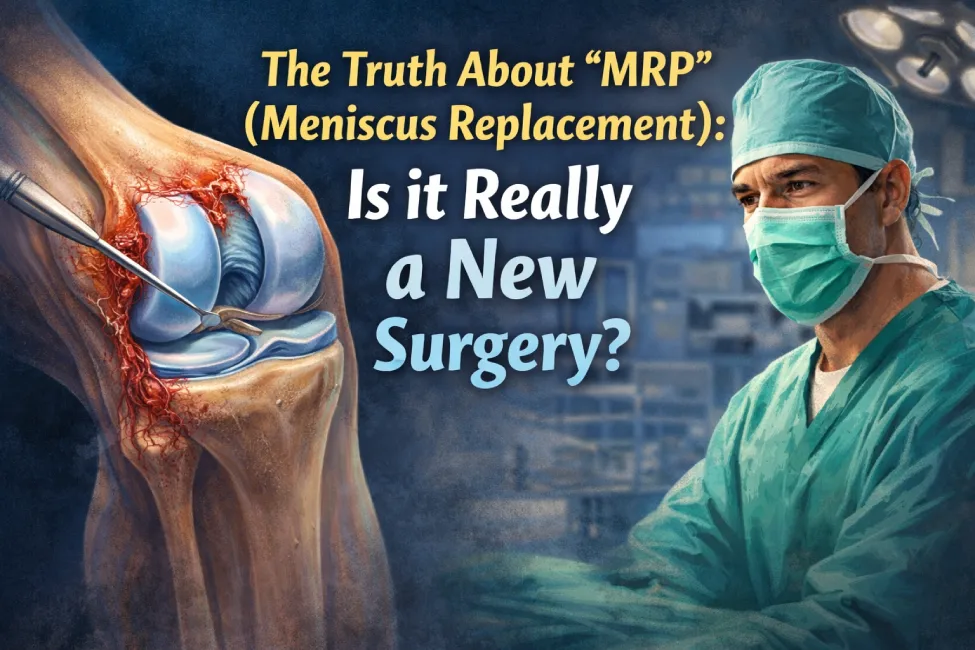
If you’ve been scrolling through Instagram or YouTube lately, you’ve probably seen viral reels by senior orthopedic surgeons—especially from Delhi—talking about a “revolutionary” new knee surgery called MRP or Meniscus Replacement.
At our clinic, we are seeing a growing number of patients in their 40s and 50s asking:
“Doctor, can I get this MRP surgery instead of a total knee replacement?”
While the term sounds like a major medical breakthrough, it’s important to separate marketing hype from medical reality. Let’s break down what MRP actually is, why it’s trending, and whether it’s truly the right solution for your knee pain.
What is MRP? (The “Marketing” vs. The “Medical”)
In many viral videos, MRP is used as a catchy acronym for a “Meniscus Replacement Procedure.” However, in the international medical community, this is not a new or separate surgery.
The Reality: “MRP” is a marketing name for what we medically call Unicompartmental Knee Arthroplasty (UKA) or, more simply, Partial Knee Replacement.
The reason it is being called “Meniscus Replacement” in social media circles is that the specific implants used (like the Oxford Partial Knee) feature a high-grade plastic “mobile bearing” that slides between the metal components, mimicking the natural shock-absorbing function of a meniscus.
Why Is It Better Than a Total Replacement?
For the right patient, a Partial Knee Replacement (or “MRP”) is far superior to a total replacement because:
- Bone Sparing: We only replace the worn-out side (usually the inner/medial side). The healthy bone and cartilage are left untouched.
- Ligament Preservation: Unlike a total replacement, your ACL and PCL are preserved, meaning the knee feels “natural” and stable when you walk.
- Smaller Incision: The surgery is minimally invasive, leading to less blood loss and minimal scarring.
- The Catch: Patient Selection is Everything
While the reels make it look like a “cure-all,” MRP is not for everyone. It only works if your arthritis is limited to one compartment of the knee. If you have “bone-on-bone” rubbing on both sides or behind the kneecap, a partial replacement will likely fail within months.
Implants, Costs, and Recovery
We use world-class implants that are time-tested for over 30 years.
| Feature | Details |
|---|---|
| Top Implant Brands | Zimmer Biomet (Oxford Knee), Stryker (Restoris), Meril (Opulent) |
| Approximate Cost | ₹1,50,000 to ₹2,50,000 (Per Knee, depending on implant choice) |
| Hospital Stay | 1 to 2 days |
| Recovery Time | Walking with support within 4 hours; full mobility in 2–4 weeks |
Can We Do It?
Yes. We specialize in Unicompartmental Knee Arthroplasty (UKA) using the exact same mobile-bearing technology marketed as MRP. We believe in providing the latest technology without the “gimmick” names—just honest, evidence-based surgery.
If you are in your 40s or 50s and struggling with inner knee pain that hasn’t responded to physio, you might be the perfect candidate for this bone-sparing procedure.
Frequently Asked Questions
- Your pain is localized to only one side of the knee (usually the inner side).
- Your ACL and PCL ligaments are intact and healthy.
- You still have a good range of motion (you can still straighten your leg).
- You are in your 40s or 50s and want to delay a total knee replacement for 15–20 years.
International Implants (e.g., Zimmer Biomet Oxford, Stryker): ₹2,00,000 – ₹2,80,000
- Day 0 (Surgery Day): You are usually encouraged to stand or walk a few steps with a walker.
- Week 1: You can move around the house; physical therapy begins.
- Week 2–4: Most patients return to desk jobs and light driving.
- Month 3: You can typically return to low-impact sports like swimming, cycling, or brisk walking.