
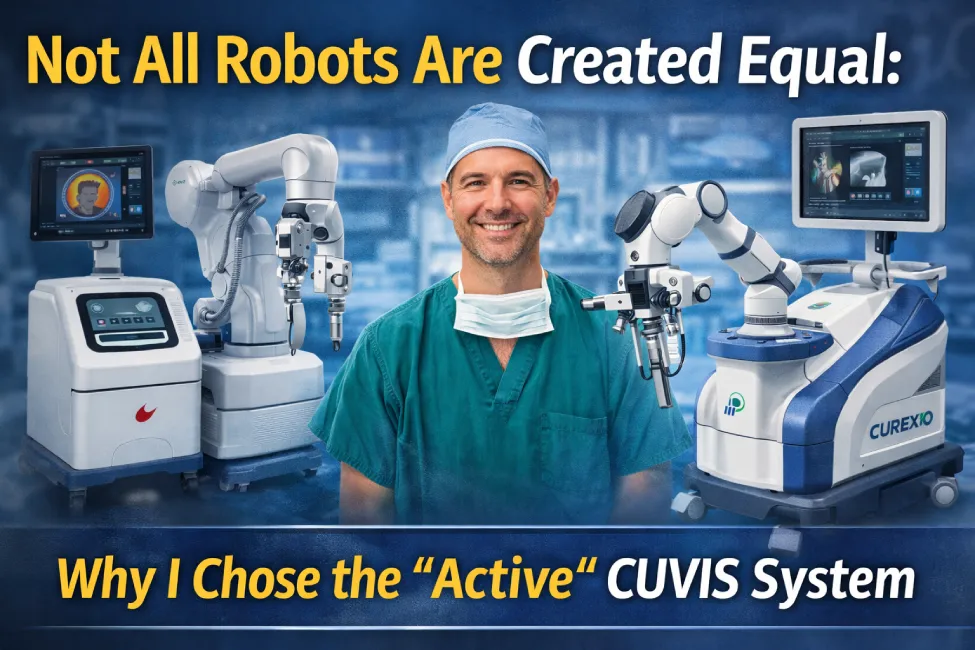
In the last 5 years, “Robotic Surgery” has become a buzzword in Mumbai. You will see it on billboards from Dahisar to Andheri. But here is the technical reality check: Most of those “robots” are not actually robots.
They are “Passive” or “Semi-Active” systems. They are essentially fancy GPS navigators that guide the surgeon’s hand, but the surgeon still holds the vibrating saw.
At Criticare Asia, I use the CUVIS Joint System. It is India’s first Fully Active robot. Here is why that distinction matters to your knee.
Active vs. Passive: The Showdown
| Feature | Passive / Semi-Active Robots (Competitors) | CUVIS Active Robot (My Choice) |
|---|---|---|
| Who Cuts the Bone? | The Surgeon (Manual Saw) | The Robot (Autonomous Arm) |
| Human Tremor Risk | Possible (Hand-held) | Zero (Robot is stable) |
| Precision | ~1–2 mm | Sub-millimeter |
| Bone Conservation | Standard | Maximal (Pre-planned 3D mapping) |
Why “Active” Means a Better Knee
Because the CUVIS arm performs the cut autonomously (under my supervision), it is rock steady. It doesn’t fatigue. It doesn’t shake.
- Less Pain: It mills the bone gently rather than sawing it, which means less trauma to your tissues.
- Better Bond: The cut is so smooth that the implant fits like a puzzle piece. This “press-fit” is crucial for long-term survival of the joint.
The “Bone Saving” Secret
Many of my younger patients (45-55 years old) worry about losing too much bone. The CUVIS system uses a CT-Scan based 3D Model of your specific anatomy. We do a “Virtual Surgery” on the computer before we even touch you.
This allows me to see exactly how much bone to remove to get perfect alignment—and not a millimeter more. We save more of your natural bone, which is vital if you need a revision surgery 20 or 25 years down the line.
Choose the technology that protects your future.