
If you are reading this, you have probably already decided that Robotic Knee Replacement is the future. You have done your Google research. You have seen the ads. You know that technology has moved on from the hammer-and-chisel era of orthopedics.
You are right. But there is a secret in the industry that most shiny hospital brochures won’t tell you:
A robot is only as smart as the surgeon controlling it.
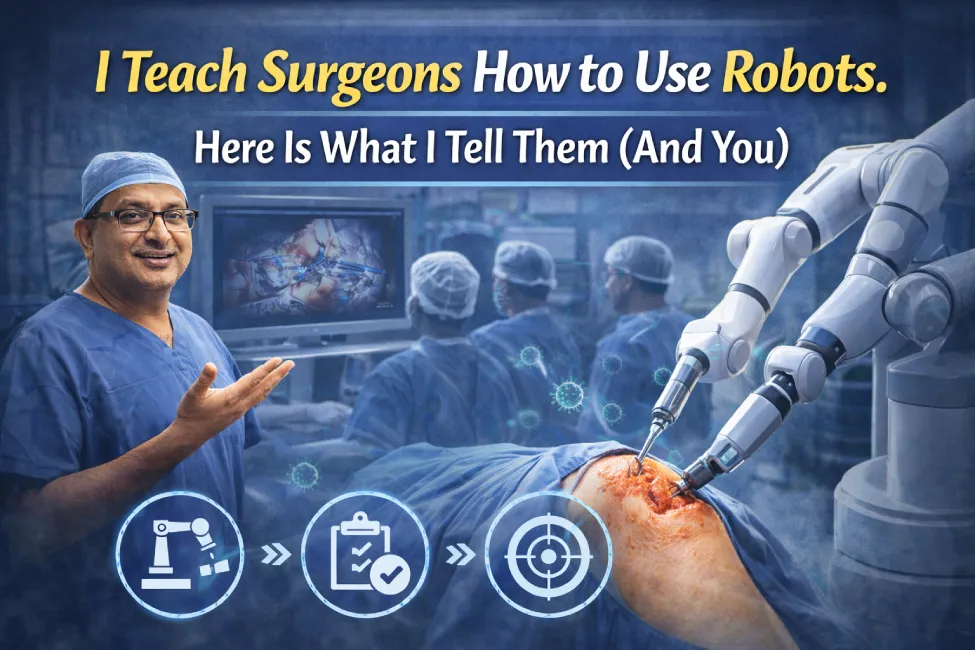
I am Dr. Govind Baranwal, and I don’t just use robotic technology to operate on my patients at Criticare Asia (Andheri) and Aum Superspeciality (Borivali). I train other orthopedic surgeons in Mumbai on how to use it.
When I am in the OT teaching a room full of visiting doctors, I start with one fundamental truth: “The robot gives you sub-millimeter precision. But it cannot give you judgment.”
The “Pilot vs. Autopilot” Reality
To understand why your choice of surgeon matters even more with robotic surgery, think of the CUVIS Joint Robot like the autopilot on a modern Boeing aircraft. It can fly smoother, straighter, and safer than any human pilot. It makes thousands of micro-calculations per second. But would you board that plane if there was no pilot in the cockpit to handle the takeoff, the landing, or the sudden turbulence?
Of course not.
In my operating theatre, the dynamic is the same:
- The Robot executes the bone cuts with 0.1mm accuracy. It eliminates the natural human tremor. It is technically perfect.
- I (The Surgeon) design the flight plan. I determine exactly where to cut based on your lifestyle, your bone quality, and your anatomy.
If the plan is wrong, the robot will execute a wrong plan perfectly. That is why the “Who” matters just as much as the “What.”
What I Teach Surgeons (That Patients Need to Know)
When I train junior surgeons or colleagues transitioning to robotics, we focus on three pillars that directly impact your ability to walk pain-free for the next 20 years.
- The “Forgetting Point”
My goal isn’t just to give you a straight knee. It is to give you a knee you forget you have. A robotic arm can cut a straight line. But a human knee isn’t just bone; it’s a complex web of soft tissues, ligaments, and tension. If a surgeon relies solely on the robot’s default settings, the knee might look perfect on an X-ray but feel “tight” or “clunky” when you walk. I teach surgeons how to use the robot’s data to balance the soft tissue. We adjust the implant position by fractions of a millimeter to ensure that your ligaments are neither too loose nor too tight. This is the difference between a mechanical-feeling knee and a natural-feeling knee.
- Handling the “Curveballs”
In India, we often see patients with softer bone density or severe deformities (bow-legs) that have been neglected for years. A novice robotic surgeon might struggle when the anatomy doesn’t match the textbook. Because I have performed over 1,500+ joint procedures and handled complex trauma cases, I know how to adjust the robotic plan instantly. For example, if the bone is osteoporotic, I program the robot to make a slightly different cut to ensure the implant sits securely. This judgment comes from experience, not software.
- The “Kill Switch” Safety Protocol
Safety is the number one fear patients have. “What if the robot goes rogue?” I use the 3rd Generation Active CUVIS System, which has multiple safety redundancies. One of the most critical features I demonstrate to trainees is the Bone Motion Monitor. If a patient moves even a millimeter—perhaps due to breathing or a muscle twitch—the robot senses it and instantly stops. It freezes. I teach surgeons to trust this feature. It ensures that we never, ever damage a nerve, artery, or healthy ligament. The robot is a cage of safety, but the surgeon holds the key.
Why This Matters to You
Many clinics in Malad, Kandivali, and Borivali have bought robots recently. It is a marketing race. But owning a robot doesn’t make you a robotic expert, just like buying a Fender Stratocaster doesn’t make you Eric Clapton.
When you choose a surgeon who is also a Trainer, you are choosing:
- Mastery: Someone who knows the machine inside out, including its limits.
- Safety: Someone who has handled hundreds of cases and teaches others how to avoid complications.
- Honesty: I know when not to use the robot (yes, those cases exist), and I will tell you if you are better suited for a different approach.
The Final Verdict
Your knee replacement is a once-in-a-lifetime event. You don’t get a “do-over.” Don’t just look for a hospital with a robot. Look for the hands that teach the others.
Ready to discuss your knee pain? Come see me at Sparsh Clinic (Borivali East) or Aum Superspeciality Hospital (Borivali West). Let’s plan your recovery together.